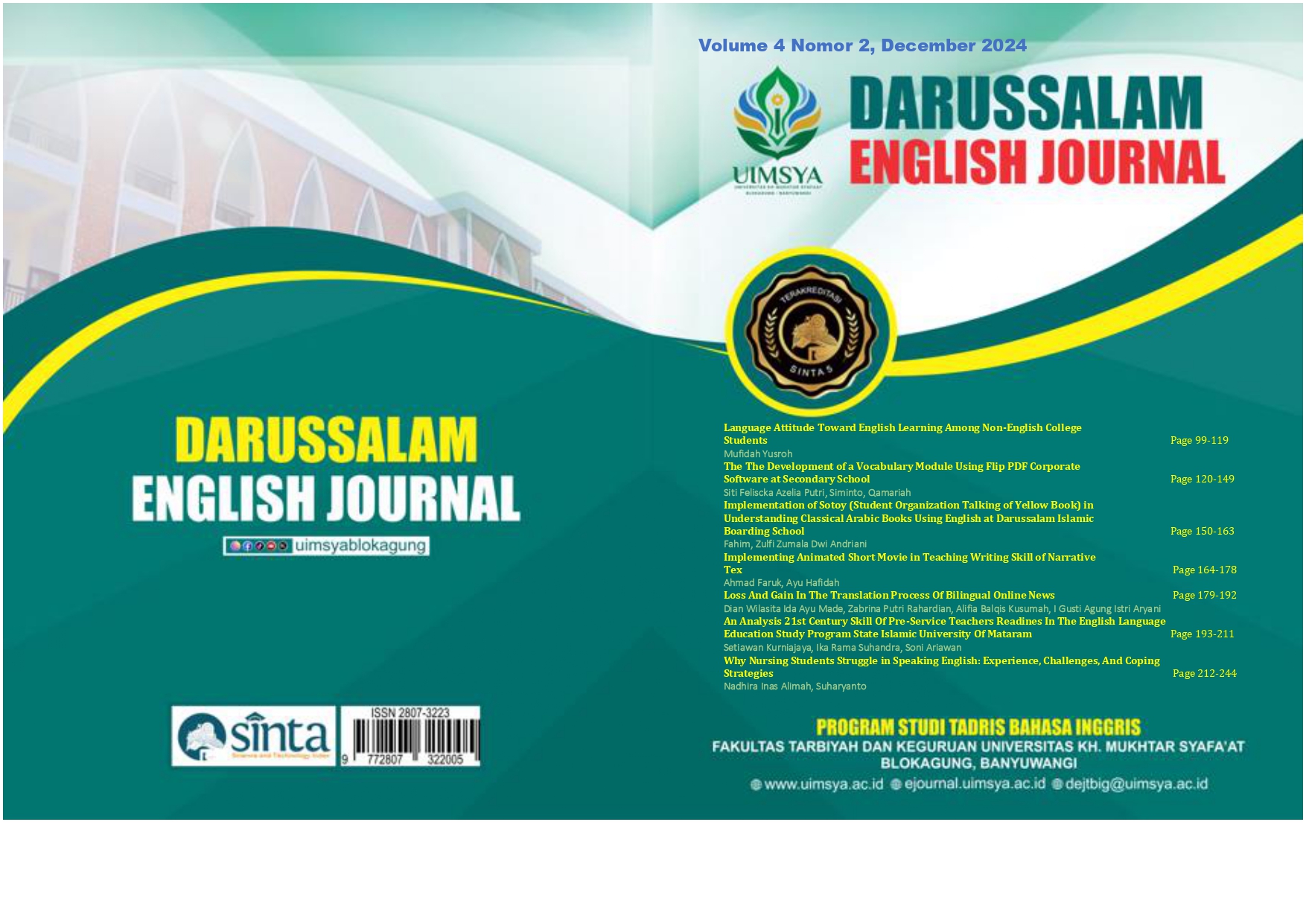
Why Nursing Students Struggle in Speaking English: Experience, Challenges, And Coping Strategies
DOI:
https://doi.org/10.30739/dej.v4i2.3395Abstract
This study aims to determine the implementation, challenges, and strategies of nursing students in improving speaking skills in the English for Nursing classroom. This research utilized descriptive qualitative methods using interviews as a data collection technique. This research addresses nursing students in their second semester at Private Health Universities in Central Java, Indonesia, who are currently enrolled in an English course this semester. The results found that the implementation of speaking activity in the English for nursing classroom was in the form of roleplay. Meanwhile, the topic applied in the activity mostly related to the nursing daily routine in the hospital. The challenges faced by nursing students are the limited English vocabulary and accent barriers that affect pronunciation in speaking English. Students utilize the Google Translate application feature and music as a strategy in overcoming the challenges of improving speaking skills. This study also revealed that the implementation used by lecturers and strategies owned by nursing students are considered to be able to overcome challenges in improving English speaking skills.
Downloads
References
Akhmadullina, R. M., Abdrafikova, A. R., & Vanyukhina, N. V. (2016). The use of music as a way of formation of communicative skills of students in teaching English language. International Journal of Environmental and Science Education, 11(6), 1295–1302. https://doi.org/10.12973/ijese.2016.400a
Fadilah, F., & Fauziah Habibah, F. A. (2021). Input and Output To Improve English Speaking Skills Based on Youtube Video Lessons. Pujangga, 7(2), 217. https://doi.org/10.47313/pujangga.v7i2.1468
Guthrie, E. M. (1988). Richards, Jack C. and Theodore S. Rogers, Approaches and Methods in Language Teaching: a description and analysis . Cambridge: Cambridge University Press, 1986 . The Canadian Modern Language Review, 44(3), 551–551. https://doi.org/10.3138/cmlr.44.3.551
Khasanah, U., Madjdi, A. H., & Nuraeningsih, N. (2022). Students’ perception on the use of Google Translate in learning Pronunciation. Borneo Educational Journal (Borju), 4(1), 50–60. https://doi.org/10.24903/bej.v4i1.912
Kristiani, P. E., & Pradnyadewi, D. A. M. (2021). Effectiveness of YouTube as Learning Media in Improving Learners’ Speaking Skills. The Art of Teaching English as a Foreign Language, 2(1), 7–11. https://doi.org/10.36663/tatefl.v2i1.97
Nashriyah, Syahabuddin, K., & Suryadi, A. (2017). Gender Awareness and Beliefs of Pre-Service English Language Teachers in Aceh. Aricis Proceedings, 1, 636–649.
Nassaji, H. (2015). Qualitative and descriptive research: Data type versus data analysis. Language Teaching Research, 19(2), 129–132. https://doi.org/10.1177/1362168815572747
Pinatih, I. G. A. D. P. (2021). Improving Students’ Speaking Skill through Role-Play Technique in 21st Century. Journal of Educational Study, 1(2), 95–100. https://doi.org/10.36663/joes.v1i2.159
Downloads
Published
How to Cite
Issue
Section
Citation Check
License
Copyright (c) 2024 Nadhira Inas Alimah, Suharyanto

This work is licensed under a Creative Commons Attribution-ShareAlike 4.0 International License.