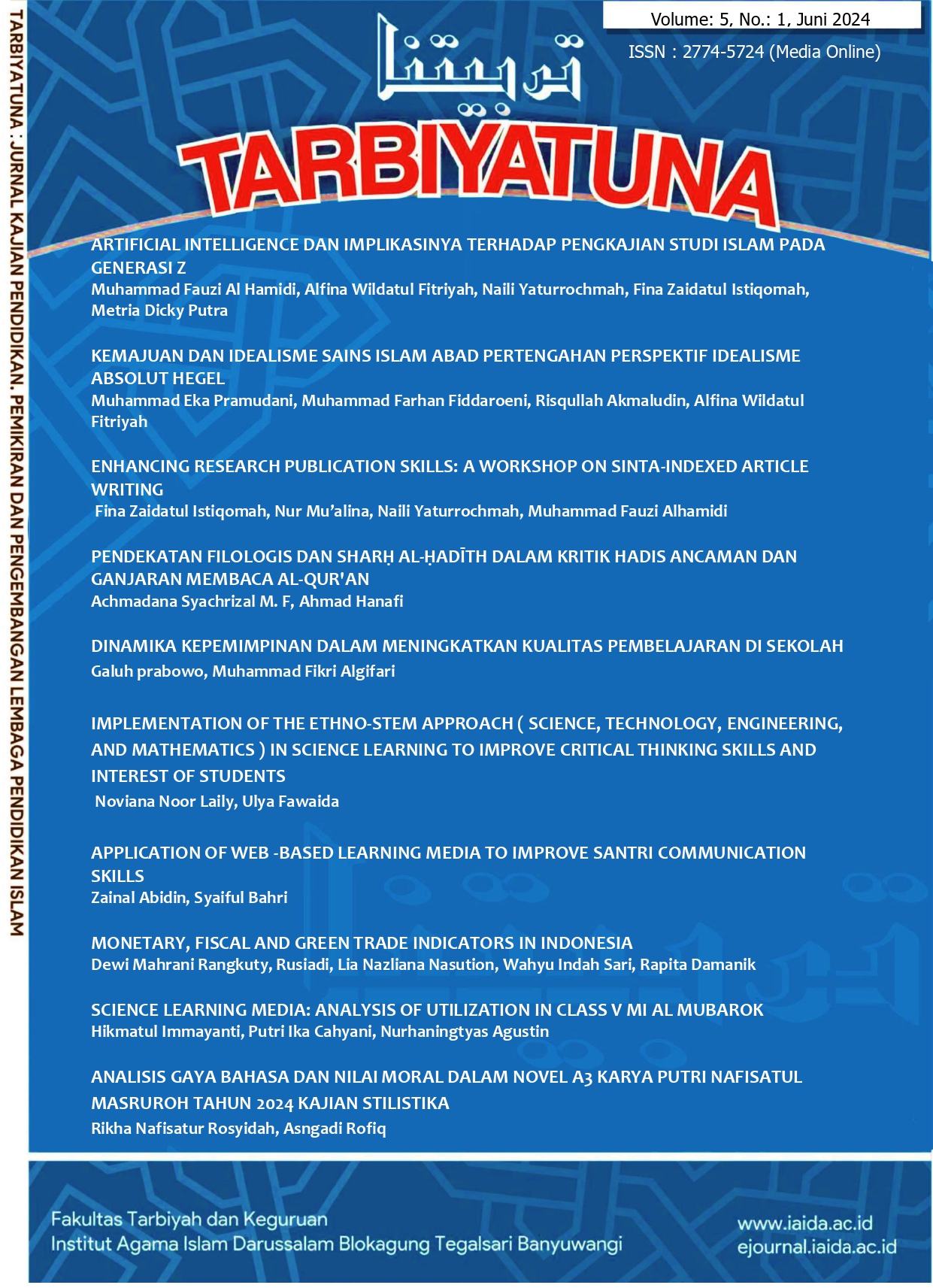
MONETARY, FISCAL AND GREEN TRADE INDICATORS IN INDONESIA
DOI:
https://doi.org/10.30739/tarbiyatuna.v5i1.3355Keywords:
Fiscal, Green Trade, Monetary, IndonesiaAbstract
Monetary policy, fiscal policy, and green trade are distinct yet interconnected elements that influence the economy. In this research, research is conducted by utilising studies which are similar or related. After collecting various literature related to the study under study, the researcher makes observations then the object of research is explored through various library information both from books, natural journals, digital data, documents and so on in order to analyse monetary, fiscal and green trade indicators in Indonesia. Governments might use fiscal measures, such as tax incentives for green technologies, to promote environmentally friendly trade practices. Central banks can support green trade by considering environmental risks in their financial stability assessments and potentially incorporating sustainability criteria into their monetary policy frameworks.
Downloads
References
Afriani, C. F. (2022). Prediksi Interaksi Kebijakam Moneter dan Fiskal dalam Pergerakan Stabilitas Ekonomi di 3 Negara Emerging ,Market.
Agusmiananta, N., Militina, T., & lestari, D. (2017). Pengaruh JUmlah uang beredar dan tingkat suku bunga serta pengeluaran pemerintah terhadap inflasi di Indonesia. Jurnal Ekonomi Manajemen Akuntansi, volume 19(2).
Agusmianataa, N., Theresia , M., & Diana , L. (2007). Pengaruh jumlah uang beredar dan tingkat suku bunga serta penegluaran pemerintah terhadap Inflasi di Indonesia. journal feb Unmul, volume 19(2).
Amiruddin, & Sudirman. (2012). Perpajakkan Pendekatan Teori dan Praktik di Indonesia . Jakarta: Salemba Empat.
Arisandy, D. A. (2016). Analisis Model taylor rule dalam penerapan inflation targetimg framework di indonesia. Jurnal Ilmiah.
Ashgar, Z. (2008). Energy-GDP Realationship:A Causal Analysis for the five countries of south Asia . Applied econometrics and International Development, vol.8 No 1 pp: 17-180.
Aulia, & ASDI. (2008). Perdagangan Internasional dan Restrukturisasi Industri TPT di Indonesia. Jurnal administrasi Bisnis , Vol,4 No. 1( ISSN : 0216-1249), 49.
Claeys, P. (2004). Monetary and Budgetary policy interaction :an SVAR analysis of stabilistion policies in monetary union. Economic Working Papers.
Dumairy. (2006). Perekonomian Indonesia. Jakarta: Erlangga.
Erawati, & F, E. (1999). Prinsip-prinsip Hukum perdagangan Internasional dan Pengecualiannya Menurut GATT/WTO paper kuliah peranan Hukum dalam pembangunan ekonomi.
Fatmala, W. K. (2016). Kebijakan Moneter Dan Ekonomi Riil Indonesia Pendekatan Structural Vector Regression. Jurnal Ekonomi.
Febrianti, R., Tiro, M. A., & Sudarmin, S. (2021). Metode Vector Autoregressive (VAR) dalam menganalisis Pengaruh kurs uang terhadap ekspor dan impor di indonesua. Journal of statistics and its application on teaching and research .
Goeltom, M. S. (2017). Kordinasi kebijakan moneter dan fiskal:tantangan dan strategi pemeliharaan stabilitas makro dan pertumbuhan ekonomi untuk mewujudkan kesejahteraan masyarakat. jurnal ekonomi.
Indonesia. (2004). UU No.3 Tahun.
Indriyani, S. N. (2016). Analisis Pengaruh Inflasi dan Suku Bunga Terhadap Pertumbuhan Ekonomi DI Indonesia. Jurnal Manajemen Bisnis Krisnadwipayana, ISSN : 2338 - 4794 VOL, 4. No. 2.
Kurniarahman, L., laut, T. L., & Prasetyanto, k. p. (t.thn.). Analisis Faktor-faktor yang mempengaruhi emisi co2 di Indonesia. Jurnal Of Economic, volume 2 Nomer 2.
Li, J., Xiucheng Dong, & Kangying, d. (t.thn.). Is China's green grwoth possible? The roles of green trade and green energy. Economic Resesarch-Ekonomska Istra zivanja, 2022.
Liu, H., Liu, H., & Zhou, Y. (2022). How does green trade affect the environment? Evidence from China. Journal of Economic Analysis, 1(1), 1-19.
Mangkoesoebroto, & Guritno. (2002). Ekonomi Publik Yogyakarta BPEE.
Manurung, J. .., & Manurung, A. (2005). Ekonometrika teori dan aplikasi . Gramedia.
Moleong, Lexy J. (2007). Metodologi Penelitian Kualitatif Edisi Revisi. Bandung: Remaja Rosdakarya.
Mujiatun, S. (2017). Kebijakan montere dan fiskal dalam Islam. jurnal ekonomi.
Nachrowi, U. D. (2006). Ekonometrika untuk analisis ekonomi dan keuangan: pendekatan populer dan prakstis. Fakultas Ekonomi Universitas Indonesia.
Nasution, L., Novalina, A., & Ruslan, D. (2020, April). Effectiveness of Fiscal Policies in Controlling Inflation in Indonesia with the Seemingly Unrelated Regression Model. In The 3rd International Conference Community Research and Service Engagements, IC2RSE 2019, 4th December 2019, North Sumatra, Indonesia.
Pratiwi, D. R. (2021). Analisis hubungan kausalitas pertumbuhan ekonomi,konsumsi energi dan Emisi CO2 di Indonesia pada periode 1980-2019. Jurnal Budget VOL 6,NO 1, 2021.
Purwanto. (2008). Metodologi Penelitian Kuantitatif Untuk Psikologi dan Pendidikan. Yogyakarta: Pustaka Pelajar.
Rangkuty, D. M., & B, M. (2022). Ekonomi Moneter Internasional. Mataram : LPPM Undikma.
Rangkuty, D. M., Nasution, L. N., Hasyyati, Z., Siregar, S. D., Firmansyah, D., & Rusiadi, R. (2024, February). HOW IS THE MONETARY AND FISCAL POLICY RELATED TO INTERNATIONAL TRADE?. In International Conference on Humanity Education and Society (ICHES) (Vol. 3, No. 1).
Rusiadi, & Nur, S. R. (2014). Metode Penelitian - Manajemen, Akuntansi dan Ekonomi Pembangunan. USU Press.
Rusiadi, R., Adivia, A., Yusuf, M., & Rangkuty, D. M. (2024, February). THE IMPACT OF THE GREEN ECONOMY ON SUSTAINABLE DEVELOPMENT IN THE ABRIC COUNTRIES. In International Conference on Humanity Education and Society (ICHES) (Vol. 3, No. 1).
Rusiadi, Novalina, A., Khairani , P., & utama siahaan, a. (2016). Prediksi Pola Stabilitas Ekonomi Makro Indonesia ( Model Mundell-Flamming). Jurnal Ekonomi dan Keuangan , 2321-5933, p-ISSN: 2321-5925.VOLUME 7, issue 5 ver ll ,PP 16-23.
Sallama, A. (2012). Ekonometrika : esensi dan aplikasi dengan menggunakan Eviews. Erlangga.
Samsul, E., Nur aeni, & Necayanti. (2021). Kebijakan Fiskal dan Moneter di Indonesia Serta pengaruhnya terhadap pasar Domestik di masa Pandemi COVID-19 . Jurnal Accounting Information System (AIMS), volume 4 no 2.
Sari, W. I., Novalina, A., & Hasanah, U. (2020). Pandemic Bonds Analysis of Inflation And Economic Growth In Overcoming Covid-19 Outbreak In Indonesia.
Sidik, M. (2017). Pengelolaan aset dan Kebijakan Fiskal.
Solikin, P. W. (2003). Kebijakan Moneter di Indonesia. Jakarta Pusat.
Spyromitros, E. (2023). Determinants of Green Innovation: The Role of Monetary Policy and Central Bank Characteristics. Sustainability 2023, 15, 7907 pp. 1-23. https://doi.org/10.3390/su15107907
Warjiyo, P. (2006). Stabilitas sistem perkembangan dan kebijakan moneter:keterkaitan dan perkembangannya di Indonesia. Buletin Ekonomi Moneter dan Perbankan.
Xu, X. (2022). The impact of natural resources on green growth: the role of green trade. Resources Policy, 78, 102720.
Zed, Mestika. (2004). Metode Penelitian Kepustakaan Cet. ke-1. Jakarta: Yayasan Obor Indonesia.
Zuldafrial. (2012). Penelitian Kuantitatif. Yogyakarta: Media Perkasa.
Downloads
Published
How to Cite
Issue
Section
Citation Check
License
Copyright (c) 2024 Dewi Mahrani Rangkuty, Rusiadi, Lia Nazliana Nasution, Wahyu Indah Sari, Rapita Damanik

This work is licensed under a Creative Commons Attribution-ShareAlike 4.0 International License.
Authors who publish in Jurnal Tarbiyatuna: Jurnal Kajian Pendidikan, Pemikiran dan Pengembangan Pendidikan Islam agree to the following terms:
- Authors retain copyright and grant the journal right of first publication with the work simultaneously licensed under a Attribution-ShareAlike 4.0 International (CC BY-SA 4.0) Licensethat allows others to share the work with an acknowledgment of the work's authorship and initial publication in this journal.
- Authors are able to enter into separate, additional contractual arrangements for the non-exclusive distribution of the journal's published version of the work (e.g., post it to an institutional repository or publish it in a book), with an acknowledgment of its initial publication in this journal.
- Authors are permitted and encouraged to post their work online (e.g., in institutional repositories or on their website) prior to and during the submission process, as it can lead to productive exchanges, as well as earlier and greater citation of published work (See The Effect of Open Access).